Let Us Know How We Can Help. We Are Your Dedicated Solutions Provider.

How to Choose the Right Electronic Board in 2026
Choosing the right electronic board in 2026 is less about chasing the newest specification and more about matching the board to its working conditions. A controller mounted beside a warm motor faces different demands from a compact board inside a handheld sensor. Board type, layer count, copper weight, materials, and assembly quality can affect heat, signal integrity, durability, and cost. Small details matter.
Grand View Research’s Printed Circuit Board Market Size, Share & Trends Analysis Report estimated the global PCB market at USD 76.26 billion in 2023 and projected a 5.4% compound annual growth rate from 2024 to 2030. That growth signals a crowded, changing supply landscape, not a guarantee that any one board will suit your product. IPC president and CEO John Mitchell has described electronics as “the most important industry in the world, because every other industry depends on it.” The quote captures the stakes, but it does not replace engineering checks.
This guide weighs practical selection factors: operating temperature, vibration, available space, power needs, production volume, and component availability. It also explains when a rigid, flexible, or rigid-flex design may make sense, and what to confirm with a manufacturer before ordering prototypes. A board that looks perfect in a CAD file may behave differently in a hot enclosure or after repeated handling. There is no universal winner. Even a careful checklist can miss a constraint, so validate critical choices with testing and qualified engineering review.
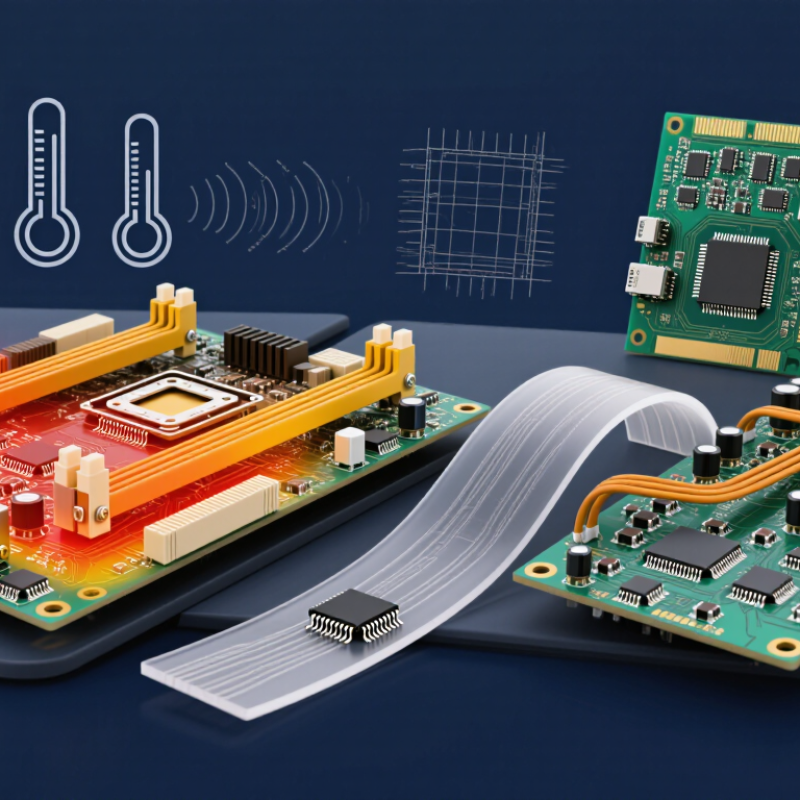
Table of Contents
[Hide]
Define the Application and Performance Requirements
Before comparing electronic boards, write down what the device must do in its real environment. Specify inputs, outputs, processing load, communication methods, and expected operating life. A sensor node in a warm factory may need stable readings and wide temperature tolerance; a handheld controller may prioritize low power and compact dimensions. Measure peak current, not just typical use. Small omission, big redesign.
WSTS’s Fall 2024 forecast projected global semiconductor sales of $697 billion in 2025, an 11.2% increase over 2024. This market figure does not identify the best board, but it reinforces the value of checking component availability and lifecycle status early. For each candidate, compare processor capacity, memory, interface count, power draw, and thermal limits against measured requirements. Leave sensible headroom for workload spikes, but avoid paying for capacity the product will never use. A spreadsheet helps; it will not replace testing.
Turn requirements into bench tests before committing to a design. Run the heaviest data task while monitoring temperature and supply voltage. Test the required interfaces with actual cables, sensors, and peripherals. Record startup time, power consumption, and error rates under normal and worst-case conditions. One caveat: early measurements can be misleading if the prototype’s enclosure or firmware differs from production. Recheck the critical results when those details change.
How to Choose the Right Electronic Board in 2026 - Define the Application and Performance Requirements
| Application | Typical workload | Suitable board class | Key performance requirements | Interfaces and design checks |
|---|---|---|---|---|
| Basic sensing and control | Read switches or sensors, run simple control logic, and operate at low data rates. | Microcontroller board | Choose enough flash, RAM, GPIO, and timer channels for the application; prioritize low power if battery life matters. | Check ADC resolution and input range, digital voltage levels, watchdog support, and sleep-mode current. |
| Connected sensor or gateway | Collect sensor data, communicate with a network, and perform light local processing. | Microcontroller or communications-focused board | Match memory and processing capacity to data rates, protocol stack, and expected firmware growth; account for radio peak current. | Verify required wired or wireless protocols, antenna clearance, connector access, and applicable regional radio approvals. |
| Human-machine interface | Drive a display, scan touch or keypad input, and update a graphical interface. | Microcontroller board with display support, or an application-processor board for richer interfaces | Size RAM and graphics capability for display resolution, color depth, refresh needs, and interface complexity. | Confirm display interface and timing, touch-controller compatibility, backlight power, and enclosure viewing conditions. |
| Edge vision or audio processing | Process camera or audio streams, run demanding algorithms, or perform local machine-learning inference. | Application-processor or compute-module board | Evaluate processor throughput, memory bandwidth, RAM capacity, storage, and any required hardware acceleration using the intended workload. | Check camera or audio interfaces, high-speed signal routing, thermal dissipation, boot storage, and software support lifecycle. |
| Motor or power control | Generate timed control signals, monitor current or position, and coordinate power switching. | Real-time microcontroller board, often paired with a suitable power stage | Define control-loop timing, PWM channels, timer resolution, fault-response needs, and isolation requirements. | Confirm voltage and current ratings of the complete power system, protection circuits, grounding, thermal limits, and electrical safety requirements. |
| Industrial monitoring or control | Operate continuously, interface with equipment, and tolerate electrical noise or a wider temperature range. | Industrial-rated controller or application-specific board | Set operating-temperature, uptime, service-life, and response-time targets from the installation environment and process needs. | Review isolation, surge and ESD protection, connector retention, EMC performance, and relevant product or industry standards. |
| Battery-powered portable device | Run intermittent sensing or communication while meeting a defined operating-time target. | Low-power microcontroller board or purpose-designed embedded board | Estimate average and peak power across active, transmit, and sleep modes; select power management for the battery chemistry and load profile. | Check charging and protection needs, regulator efficiency, battery monitoring, leakage current, and enclosure space for the cell. |
Selection note: These are general design starting points, not fixed specifications. Confirm requirements with representative workloads, measurements, environmental testing, and applicable safety or regulatory standards before finalizing a board.
Related Posts
-
Top 10 Types of Circuit Boards for Global Buyers
-

How to Find a Reliable Circuit PCB Supplier in 2026?
-
What Are the Top Types of Printed Circuit Boards?
-
How to Create a Circuit Board for Your Electronics Projects?
-
10 PC Board Buying Tips for Global Buyers?
-

Top 10 Printed Circuit Board Manufacturers Worldwide