China Top Printed Circuit Board Manufacturing Companies?

Choosing the China top printed circuit board manufacturing companies requires more than comparing factory size or export volume. A credible review should examine engineering depth, production consistency, certifications, delivery performance, and customer support. It should also distinguish mass-production suppliers from specialists in HDI, rigid-flex, high-frequency, automotive, and semiconductor packaging boards.

IPC industry analyst Walt Custer has observed, “The electronics industry is a global industry, and the supply chain is global.” That reality makes supplier selection more complicated. A Chinese manufacturer may offer strong pricing, automated inspection, and impressive monthly capacity. However, capacity alone does not prove dependable quality. Buyers should request recent audit records, sample test reports, traceability details, and evidence of compliance with relevant standards.

Look beyond the brochure.

This guide compares leading companies through practical criteria, including material control, impedance testing, multilayer registration, surface finishes, and response speed during engineering changes. Companies such as Zhen Ding Tech, Kinwong, Victory Giant, Shennan Circuits, and other established manufacturers may serve very different markets. Their capabilities should not be treated as interchangeable.

The ranking may still contain judgment. Public information is uneven, and supplier performance can vary by plant, product, and production period. That limitation matters. A factory that excels at smartphone boards may not be suitable for medical electronics or industrial power systems. Therefore, this overview combines documented capabilities with purchasing considerations, while encouraging readers to verify current certifications and conduct technical audits before signing a contract.
China Top Printed Circuit Board Manufacturing Companies?

What Defines a Leading Printed Circuit Board Manufacturer in China

A leading printed circuit board manufacturer in China proves capability through consistent production, not attractive promises. Its engineers understand stack-up design, impedance control, thermal management, and material selection. They can review Gerber files and identify problems before fabrication begins.

Reliable manufacturers maintain traceability from incoming laminate to final inspection. They use controlled drilling, precise imaging, automated optical inspection, and electrical testing. Certifications can support credibility, but certificates alone are not enough. A factory should provide clear process records, inspection data, and realistic delivery commitments. Communication matters too. Engineers should explain risks in practical language, not hide behind vague sales terms.

Tips: Request a sample quality report and ask how defects are handled. Check whether the same process supports both prototypes and volume production. Confirm test standards, material sources, layer-count limits, and change-control procedures. Visit the facility when possible. A video tour is useful, but it cannot reveal everything.

Experience also appears in difficult projects. Strong teams respond calmly to warpage, solder-mask issues, tight tolerances, and unexpected yield losses. They document corrective actions and prevent repeated mistakes. Still, even experienced factories can miss a detail. That is why shared drawings, written approvals, and regular technical reviews remain essential. The best partnership feels transparent, measurable, and slightly cautious. Fancy equipment helps, but disciplined habits decide long-term reliability.

China’s Major Printed Circuit Board Manufacturing Companies

China’s Major Printed Circuit Board Manufacturing Companies

China remains the largest production base for printed circuit boards, supported by dense supply chains, skilled engineers, and expanding electronics demand. Prismark’s 2024 industry forecast estimated that China contributes roughly half of global PCB production value. The China Printed Circuit Association also reported domestic output value of about RMB 415 billion in 2023. These figures explain why major Chinese manufacturers attract global automotive, telecom, computing, and consumer-electronics projects.

Large manufacturers usually compete through different technical strengths. Some operate high-volume factories for multilayer rigid boards. Others focus on high-density interconnect, flexible circuits, rigid-flex products, or automotive-grade boards. A reliable supplier should show stable layer registration, controlled impedance data, traceable materials, and documented process audits. IPC standards provide useful benchmarks, but certification alone cannot prove consistent factory performance.

Factory visits still matter.

Buyers should examine clean-room conditions, automated optical inspection, drilling accuracy, and finished-board testing. Capacity numbers can also mislead; installed equipment is not the same as available capacity. Prismark’s market data indicates continued demand from data infrastructure and vehicle electronics, yet forecasts remain sensitive to inventory cycles. A smaller specialist may sometimes outperform a larger producer on difficult prototypes. That point deserves more attention. Supplier evaluation should include delivery records, engineering communication, defect trends, and evidence from recent production lots.

Key PCB Products, Technologies, and Industry Applications

China’s leading printed circuit board manufacturers produce multilayer, HDI, flexible, and rigid-flex boards for demanding electronic systems. Standard boards support control panels and consumer devices. High-density interconnect boards use microvias and fine traces to save space. Flexible circuits bend around hinges, cameras, and compact battery modules.

Manufacturing quality depends on more than copper and laminate selection. Engineers review stack-up design, impedance targets, thermal paths, and component density. Laser drilling, sequential lamination, via filling, and automated optical inspection improve consistency. Electrical testing can identify open circuits, short circuits, and weak connections. Experienced teams also use design-for-manufacturing reviews before production begins. A tiny clearance error can create costly rework.

These products serve telecommunications equipment, electric vehicles, factory automation, medical instruments, renewable-energy controls, and aerospace electronics. Automotive boards often require strong thermal cycling and vibration resistance. High-frequency systems need controlled dielectric properties and carefully measured signal loss. Medical applications demand traceable materials and stable process records. Yet no factory is perfect. Some advanced designs remain difficult to scale without yield loss. Buyers should verify certifications, sample results, layer registration, and long-term reliability data. A polished specification sheet is useful, but production evidence matters more.

China Top Printed Circuit Board Manufacturing Companies? - Key PCB Products, Technologies, and Industry Applications
Overview of major PCB product categories and manufacturing capabilities commonly available across China's PCB manufacturing sector. Technical requirements vary by supplier, material system, and product design.
PCB Product Category Typical Construction and Materials Key Manufacturing Technologies Common Technical Characteristics Primary Industry Applications Quality and Compliance Considerations
Single-Sided and Double-Sided Rigid PCB FR-4 glass-reinforced epoxy laminate, copper foil, solder mask, and surface finish. Through-hole drilling CNC routing Wave soldering compatibility Cost-effective structure for low-to-moderate circuit density and standard operating environments. Consumer appliances, LED lighting, power supplies, industrial controls, and basic automotive electronics. Dimensional stability, dielectric strength, copper adhesion, solderability, and applicable IPC workmanship criteria.
Multilayer Rigid PCB Multiple copper layers laminated with prepreg and core materials, commonly using FR-4 or high-temperature laminate systems. Sequential lamination Laser or mechanical drilling Controlled impedance Supports higher routing density, power distribution, signal integrity, and component interconnection complexity. Computers, networking equipment, telecommunications, industrial automation, medical electronics, and automotive systems. Layer registration, via reliability, resin filling, impedance testing, thermal stress testing, and AOI inspection.
HDI PCB High-density interconnect boards using fine-line copper features, microvias, build-up dielectric layers, and high-density component escape routing. Laser microvia drilling Build-up technology Via-in-pad Enables compact form factors, shorter interconnect paths, increased wiring density, and improved electrical performance. Smartphones, tablets, wearable devices, compact cameras, advanced automotive modules, and portable medical equipment. Microvia fatigue resistance, copper filling quality, fine-line etching control, registration accuracy, and reliability cycling.
Flexible PCB Polyimide or similar flexible film, rolled copper, coverlay, stiffeners, and optional electromagnetic shielding materials. Flexible-film processing Precision laser cutting Dynamic-bend design Lightweight and bendable construction that reduces wiring volume and can support repeated flexing when properly designed. Displays, cameras, printers, wearable electronics, automotive interiors, battery systems, and medical devices. Bend-cycle performance, coverlay adhesion, conductor cracking resistance, dimensional control, and cleanliness.
Rigid-Flex PCB Integrated rigid FR-4 or specialty rigid sections combined with flexible polyimide sections in one interconnected assembly. Rigid-flex lamination Flex-layer routing 3D assembly support Combines mechanical stability with three-dimensional folding, reducing connectors, cables, and assembly space. Aerospace systems, medical instruments, industrial robotics, automotive electronics, and high-reliability equipment. Flex-to-rigid transition design, bend radius, layer registration, delamination resistance, and thermal cycling.
High-Frequency and High-Speed PCB Low-loss PTFE, hydrocarbon-ceramic, modified epoxy, or other specialty laminates selected for controlled electrical performance. Controlled impedance Low-loss materials Signal-integrity simulation Designed to reduce dielectric loss, insertion loss, crosstalk, and timing distortion at higher frequencies and data rates. 5G infrastructure, radar, satellite communications, high-speed networking, automotive radar, and test equipment. Dielectric constant consistency, dissipation factor, surface roughness, impedance tolerance, and frequency-dependent testing.
Metal-Core and Heavy-Copper PCB Aluminum or copper base layers for thermal management, or increased copper thickness for high-current conduction. Thermal interface processing Heavy-copper plating Thermal simulation Provides improved heat dissipation or current-carrying capacity compared with standard copper constructions. LED modules, power converters, electric vehicles, charging equipment, industrial drives, and renewable-energy systems. Thermal resistance, dielectric isolation, copper thickness uniformity, plated-through-hole reliability, and thermal cycling.
Automotive-Grade PCB Rigid, HDI, flexible, or metal-core constructions selected for vibration, temperature, humidity, and electrical-load requirements. High-reliability assembly Automated optical inspection Traceability systems Designed for long service life and stable operation under thermal cycling, vibration, contamination, and electrical stress. Battery-management systems, advanced driver-assistance systems, infotainment, body control, powertrain, and lighting. Automotive quality systems, process traceability, thermal shock, vibration, CAF resistance, and stringent change control.
IC Substrate and Advanced Packaging Board Fine-line organic substrate materials, build-up dielectric layers, microvias, and high-density package interconnections. Fine-line patterning Microvia formation Package-level inspection Supports semiconductor package interconnection, miniaturization, high I/O counts, and controlled electrical performance. Application processors, memory packages, networking chips, consumer electronics, and high-performance computing. Warpage control, ultra-fine registration, surface flatness, solder joint reliability, cleanliness, and package compatibility.
Manufacturing and Testing Capabilities Digital production systems covering design-for-manufacturing review, fabrication, assembly coordination, and reliability testing. CAM engineering AOI and AVI Flying-probe testing Electrical testing Modern production lines commonly combine automated inspection, process monitoring, statistical control, and traceability. Prototype production, medium-volume manufacturing, mass production, export electronics, and industrial product development. ISO 9001, ISO 14001, IATF 16949 where applicable, UL recognition where required, RoHS, REACH, and IPC-based procedures.

Manufacturing Capabilities, Quality Standards, and Certifications

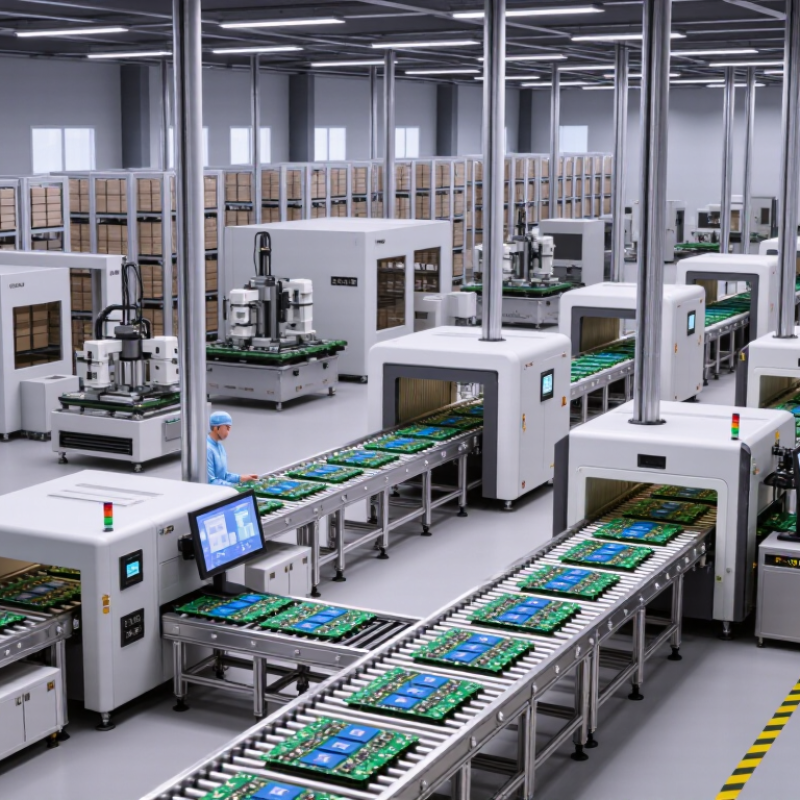
China remains the largest PCB production base. Prismark’s 2024 PCB Industry Forecast estimated that China generated roughly half of global PCB production value in 2023. This scale supports high-volume multilayer, HDI, rigid-flex, and advanced substrate manufacturing. Leading factories commonly operate automated drilling, laser via formation, copper plating, AOI, and X-ray inspection lines. Capability, however, varies sharply between facilities.

Quality control should begin with measurable standards, not attractive brochures. IPC-6012 defines performance requirements for rigid printed boards, while IPC-A-600 describes acceptance conditions. Reliable factories also monitor impedance, copper thickness, hole-wall quality, solderability, and thermal cycling. ISO 9001 supports process management; IATF 16949 suits automotive production; ISO 13485 applies to medical-device supply chains. Aerospace programs may require AS9100 certification. A certificate alone proves little.

Professional buyers should request traceability records, capability studies, failure-analysis reports, and recent audit findings. Useful evidence includes microsection images, CAF testing, peel-strength data, and lot-level material records. IPC’s 2024 Electronics Industry Impact report placed global electronics production above 5 trillion dollars, increasing pressure on stable quality and delivery. No factory is flawless. Even advanced plants can miss a defect during recipe changes or rushed production. The better question is whether the manufacturer detects, explains, and corrects that failure before shipment.

How to Evaluate and Select a Chinese PCB Manufacturer

How to Evaluate and Select a Chinese PCB Manufacturer

Selecting a Chinese PCB manufacturer requires more than comparing unit prices. Review its experience with your board type, layer count, materials, and production volume. Ask for recent examples of similar projects, not only polished photographs. A capable engineering team should check your Gerber files, stack-up, drill sizes, impedance targets, and component clearances before quoting. Their questions often reveal practical knowledge.

Request objective evidence. This may include ISO 9001 certification, process-control records, electrical test results, and material traceability. For multilayer boards, ask how the factory controls lamination pressure, copper thickness, and warpage. Confirm whether AOI, flying-probe testing, microsection analysis, and X-ray inspection are available. Visit the production site when possible. Observe storage conditions, humidity control, calibration labels, and how rejected boards are isolated.

Do not judge quality from one successful prototype. Order samples from a defined batch and measure dimensions, hole quality, solderability, and impedance. Discuss tolerance limits in writing. Delivery performance also matters, so examine historical lead-time data and escalation procedures. A lower quote may hide tooling fees, extra testing, or weaker material specifications. No supplier is perfect. A checklist can still miss communication problems. I would keep a small pilot order before committing to regular production, then record defects, response times, and corrective actions with evidence.