Let Us Know How We Can Help. We Are Your Dedicated Solutions Provider.

Choosing a Storm Door Handle Andersen replacement or compatible supplier is a small decision with daily consequences. A loose latch, cold metal lever, or misaligned strike plate can turn a quick exit into a frustrating repair. The market is broad, but not every handle fits every door model. Buyers should confirm the door series, handing, finish, screw spacing, and included hardware before comparing suppliers.
Industry context matters. Harvard’s Joint Center for Housing Studies reported that U.S. homeowners spent about $567 billion on home improvements and repairs in 2022. That figure covers far more than storm doors, but it shows why durable replacement parts and clear product information matter. Andersen’s installation instructions and product documentation are useful references for checking compatibility; supplier listings should be measured against those details, not just attractive photos or low prices.
A careful comparison should also examine material, finish durability, warranty terms, stock status, and access to installation support. Ask whether the package includes the latch, strike plate, spindle, and mounting screws. Small omissions matter.
One limitation deserves honesty. I could not verify a named industry expert’s published quotation specifically about Andersen storm-door handles, so attributing one here would be misleading. This guide instead focuses on checkable product details and reported housing data. The right supplier is not always the cheapest. Fit comes first.
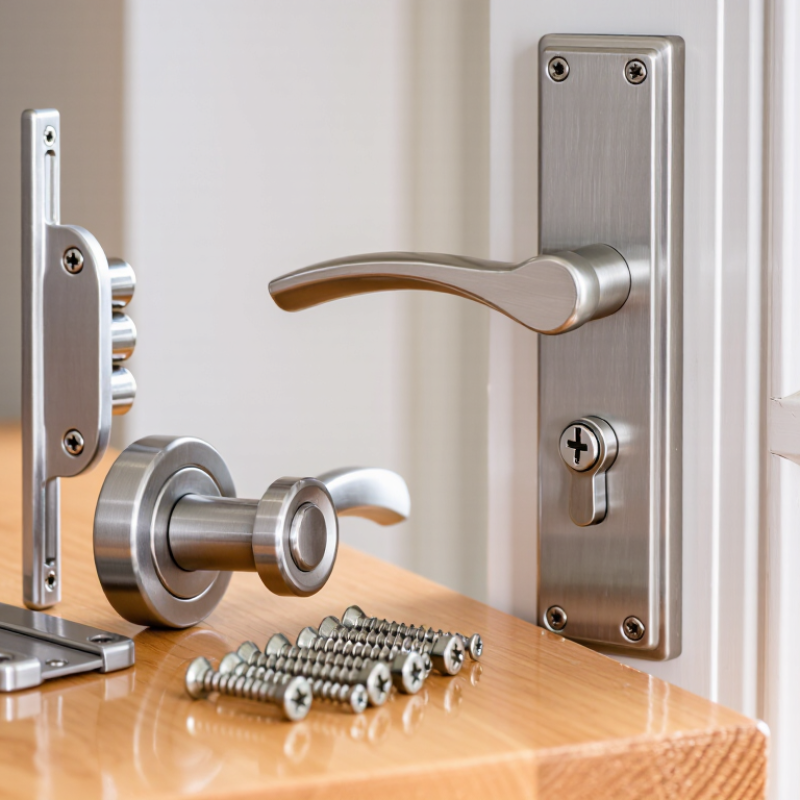
A replacement storm door handle should match the door’s hardware layout, not just its appearance. Start with the model or series number, often printed on a label near the hinge edge or concealed beneath the handle. If the label is missing, record the lock shape, screw spacing, and opening direction. A clear photo beside a ruler can help a supplier compare the existing setup. Still, photos alone may not reveal every measurement.
Measure the backset from the door’s edge to the center of the handle or lock opening. Check the spindle’s shape and length; a square spindle that is too short may not engage the interior handle. Measure door thickness at the handle area, since trim or weather seals can make a rough estimate misleading. Small differences matter. Compare these measurements with the replacement’s specifications before ordering, and confirm whether the package includes the needed spindle and fasteners. If one dimension is uncertain, measure again rather than forcing a close fit. That extra check can prevent a loose handle or a latch that fails to retract smoothly.
The chart shows two common tubular-lock backsets: 2⅜ inches and 2¾ inches. These are reference measurements, not a guarantee of handle compatibility. Before choosing a replacement, identify the door model and verify the backset, spindle fit, and door thickness against the handle specifications.
Selecting a China-based storm-door handle supplier takes more than reviewing a polished product photo. Request a current ISO 9001:2015 certificate and verify its number, validity dates, issuing body, and scope. The scope should name the actual factory and relevant processes, such as metal forming, machining, finishing, or assembly. A certificate covering only a sales office tells you little about production controls. ISO’s 2022 Survey recorded more than 1.26 million valid ISO 9001 certificates worldwide. That figure shows the standard’s reach, not the quality of any individual supplier.
Ask for recent factory audit records, including findings and corrective-action evidence. Check whether reports identify the audited site, date, auditor, and production activities. Look for practical records: incoming-material inspections, measuring-tool calibration, batch traceability, and inspection results for finished handles. Redacted documents may protect confidential details, but dates and follow-up actions should remain visible. A tidy PDF is not proof by itself; paperwork can look complete while shop-floor controls drift. That distinction matters.
Tips: Cross-check the certificate with its issuer. Compare audit dates with the factory’s current address, then request a live video walk-through of the production area. If records conflict, pause and ask for clarification.
A reliable comparison of Andersen Storm Door Handles starts with the test report, not the finish color. A 304 stainless steel handle should have traceable material identification and results tied to the tested sample or production lot. Check whether the report lists chemical composition, corrosion exposure, and the test method. “Stainless” alone is not enough. A bright surface can hide uneven finishing, especially around screw holes and sharp edges.
Zinc-alloy handles can offer precise shapes and consistent detailing, but their coating deserves close review. Look for coating thickness, adhesion results, and corrosion testing, including any visible blistering or red rust after exposure. Compare test duration and inspection criteria; two reports may use different methods, so their results are not automatically equivalent. Small print matters. Also check whether the handle was tested with its actual screws and mounting arrangement, since load and fit affect performance. A report can look tidy and still leave questions. Ask for dated, lot-linked records, then inspect a sample for rough edges, loose movement, or coating damage near the latch. I would not treat one strong test result as proof of long-term performance in every climate.
For a storm-door handle supplier, salt-spray hours matter only when the test method and results are documented. ASTM B117 defines a controlled salt-fog test; it does not set one universal pass duration or predict years of outdoor service. Ask for the report’s exposure hours, sample condition, coating description, and post-test inspection criteria. A blister-free handle after 500 hours is useful evidence, but not a lifetime guarantee.
Tips: Check that the tested sample matches the offered finish and base material. Look for dated laboratory results, not a sales-sheet claim. Coastal air, scratched coatings, and trapped water can change real-world performance.
For the lockset, request the applicable ANSI/BHMA A156.2 grade and the full test report. BHMA grading uses performance requirements that include operational-cycle testing; commonly cited benchmarks are 800,000 cycles for Grade 1, 400,000 for Grade 2, and 200,000 for Grade 3. Confirm the edition and product type, since requirements can vary.
A useful report identifies the tested model, cycle result, operating force, and any failures. Small details count: a latch that binds after repeated use can make a strong-looking handle frustrating at the door. Salt-spray results and lockset-cycle results measure different risks, so compare both before choosing a supplier.
For Andersen storm door handle sourcing, compare more than the quoted unit price. Ask each supplier for its minimum order quantity and whether mixed finishes count toward that minimum. A small trial order can reveal fit, finish, and packaging quality before a larger commitment. Check the handle’s dimensions against your door model, and request clear drawings or a physical sample. Details matter.
Lead time should be stated in writing, with production and shipping shown separately. Ask what happens if a component is delayed; vague answers are a warning, though not proof of poor performance. Warranty terms also need specifics: coverage period, exclusions, replacement process, and who pays freight for defective parts. Read the actual terms, not just a sales message.
For export readiness, request sample commercial invoices, packing lists, and applicable origin or inspection documents. Confirm that company names, product descriptions, quantities, and shipment details match across records. Ask for verifiable references or past shipment evidence, while protecting confidential customer information. Keep the comparison in one table. A supplier may offer a low MOQ but a longer lead time, or a strong warranty with limited coverage. There is no perfect scorecard; check the trade-offs against your order schedule.