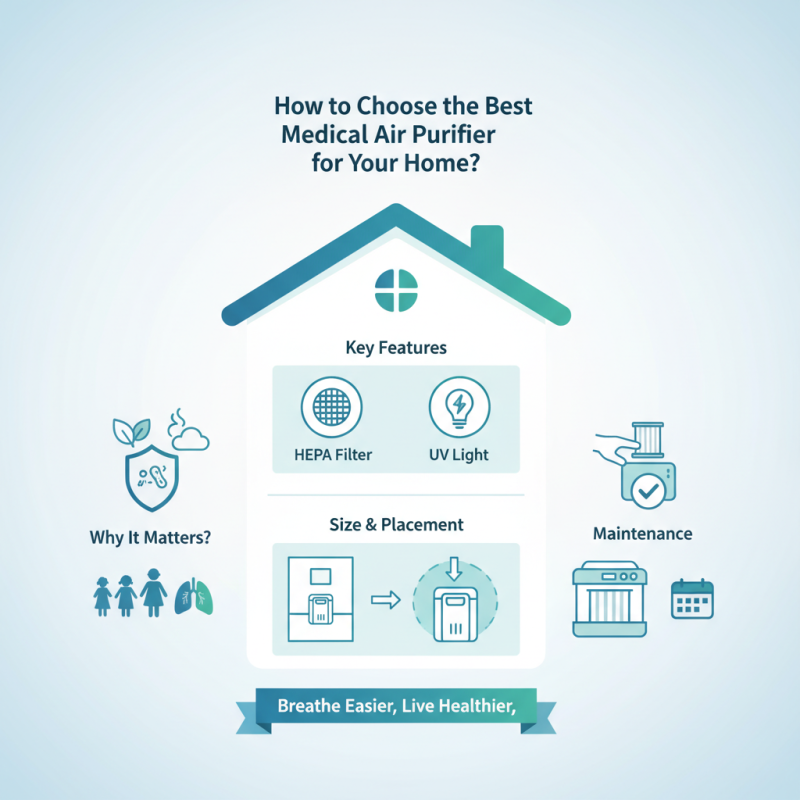
How to Choose the Best Medical Air Purifier for Your Home?
Choosing the right medical air purifier for your home is crucial. It plays a significant role in maintaining a healthy indoor environment. With various options available, families often feel overwhelmed.
An effective medical air purifier can filter out allergens, pollutants, and bacteria. It creates a safe space for children, the elderly, and those with respiratory issues. One might assume that all purifiers serve the same purpose, but that's not true. Features like HEPA filters and UV light capabilities vary widely.
Many overlook the importance of the purifier's size and placement. A unit that's too small may struggle to clean the air effectively. Regular maintenance is also essential for optimal performance. As you navigate your search, reflect on what truly meets your needs. A thoughtful decision can lead to better air quality and peace of mind.
Understanding Medical Air Purifiers: Types and Technologies Available
Medical air purifiers play a crucial role in maintaining indoor air quality. Various types are available, each utilizing distinct technologies to filter harmful particles. HEPA filters are popular. They capture air pollutants like dust, pollen, and smoke. They promise effective purification but may need frequent replacement.
Another type is the activated carbon filter. It excels at absorbing odors and harmful gases. However, it may not be as effective in removing biological contaminants. UV-C light purifiers can eliminate bacteria and viruses. Yet, their effectiveness can vary based on exposure time and air flow.
Choosing the right purifier requires careful consideration. Assess your specific needs based on air quality and potential allergens. The right device can significantly improve your living space. However, don't overlook maintenance and filter replacement reminders. Regular upkeep is essential for optimal performance.
Key Features to Look for in a Home Medical Air Purifier
When choosing a medical air purifier, several key features are essential. HEPA filters play a crucial role. They trap 99.97% of particles measuring 0.3 microns or larger. This includes common allergens, dust, and even certain bacteria. A report from the American Lung Association emphasizes that air purifiers with HEPA filters significantly reduce indoor air pollution.
Next, consider the Clean Air Delivery Rate (CADR). This metric indicates how effectively an air purifier can remove pollutants from the air. Higher CADR numbers denote quicker cleaning. For example, a purifier with a CADR of at least 300 is recommended for larger rooms. It's important to match the purifier’s capacity to your space.
Noise levels also matter. Some purifiers can be quite loud, disrupting sleep or daily activities. Look for models that operate quietly, ideally under 30 decibels. In a study published by the Environmental Protection Agency, lower noise levels are linked to improved overall well-being. During your search, remember, not every product will meet all your needs perfectly. Testing different units can help identify the right fit.
Key Features of Medical Air Purifiers
Assessing Room Size and Air Changes per Hour (ACH) Requirements
When considering a medical air purifier for your home, room size is crucial. A larger room requires a purifier with higher airflow capacity. According to the EPA, an air purifier should ideally exchange the air in a room every 30 to 60 minutes. This is quantified as Air Changes per Hour (ACH). For example, a room measuring 300 square feet needs a purifier with an ACH of at least 4 for optimal performance.
Assessing ACH requirements helps ensure effective air filtration. If the ACH is too low, pollutants linger longer in the air. In contrast, purifiers with higher ACH rates can quickly remove allergens and pathogens. A study indicated that air purifiers with an ACH of 6 significantly reduce airborne contaminants within minutes.
It’s worth noting that the efficiency of a purifier may vary based on filter quality and design. Some models may fall short in actual ACH performance compared to advertised claims. Consumers must carefully review specifications. Ultimately, ensuring the right balance between room size and ACH can enhance indoor air quality. Consider this as you evaluate different options.
Evaluating HEPA and Other Filter Efficiency Ratings for Allergens
When choosing a medical air purifier, understanding filter efficiency is crucial. HEPA filters are well-known for capturing tiny particles, including dust and allergens. They can trap at least 99.97% of particles that are 0.3 microns in size. This high efficiency is vital for those with allergies or respiratory issues. Other filters, like activated carbon, also contribute by absorbing odors and gases but may not capture smaller allergens.
Look beyond just HEPA ratings. The Clean Air Delivery Rate (CADR) is another important metric. This rate indicates how well an air purifier can filter out specific pollutants. A higher CADR means better performance for its size. However, check the recommended room size for each model. It should match your space for effective purification. Sometimes, smaller devices may underperform in larger areas, leading to disappointment.
You may find conflicting information about different models. Reviews can be mixed, leaving you unsure. Consider actual user experiences, as they often reveal the true efficiency of a purifier. Keep in mind that while features matter, overhype can lead to poor choices. A less popular option may work better than a trendy model. Reflecting on reviews and specifications is essential before making your decision.
Cost-Benefit Analysis: Long-term Savings vs. Initial Investment in Purifiers
When investing in a medical air purifier, consider both the initial cost and long-term benefits. The upfront price can be daunting. Many quality purifiers come with a premium. However, think about the health advantages they provide. Clean air can reduce the risk of respiratory issues. This leads to better overall well-being.
Assessing potential savings is crucial. Reducing illness means fewer doctor visits. This can save considerable money in the long run. Moreover, a purifier can enhance the longevity of HVAC systems. Clean air reduces wear and tear, leading to repair savings.
Installation costs are often overlooked. Some purifiers require professional setup, adding to initial expenses. However, many models are user-friendly and easy to install. Nonetheless, don’t forget about maintenance costs. Regular filter replacements can add up. Evaluate these aspects carefully to ensure you make a sound investment.