China Top 10 Refrigeration Condensing Unit Manufacturers
China’s refrigeration industry has grown from basic component assembly into a competitive manufacturing sector. Today, a reliable Refrigeration Condensing Unit supports cold rooms, supermarkets, food factories, and transport refrigeration systems. Selecting the right manufacturer requires more than comparing prices or product photographs.
This guide examines China’s top 10 refrigeration condensing unit manufacturers through practical and technical criteria. These include compressor quality, cooling capacity, energy efficiency, noise control, control systems, and production consistency. It also considers factory experience, certifications, testing procedures, export records, and after-sales support. A dependable supplier should explain performance under specific ambient temperatures, not merely quote a catalog value. Details matter. Copper tube joints, fan motors, vibration mounts, and pressure controls can affect years of operation.
Field experience shows that installation conditions often influence performance as much as the equipment itself. A well-built unit may still fail when airflow is restricted or refrigerant charging is inaccurate. That point is easy to overlook. Manufacturer claims should therefore be checked against test reports, customer feedback, and clear technical documentation. We also recognize that no ranking can remain perfect for every buyer. Product lines change, regional service differs, and some public information is incomplete. This article offers a careful starting point rather than an absolute verdict. Readers should confirm current specifications, compliance requirements, warranty terms, and local support before making a final purchasing decision.
Refrigeration Condensing Units: Definition, Components, and ASHRAE Ratings
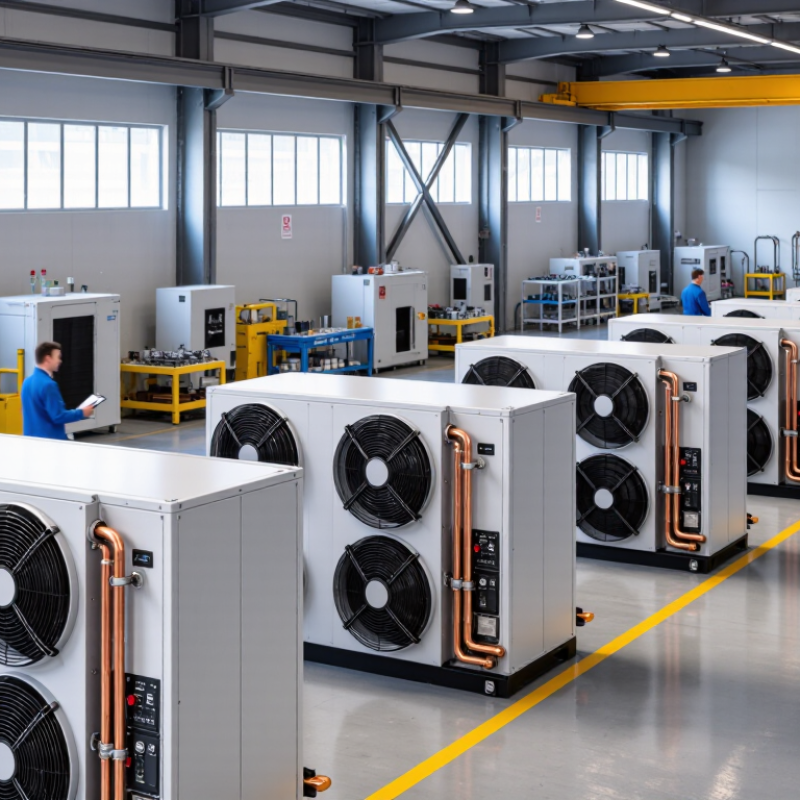
A refrigeration condensing unit rejects heat from the refrigerant and supports stable cooling inside a system. It normally includes a compressor, condenser coil, fan motor, receiver, filter-drier, sight glass, and safety controls. Some models also include a liquid line solenoid or a service-friendly controller. The compressor raises refrigerant pressure, while the condenser releases heat through finned coils and moving air. On a cold-storage site, dust on those fins can quickly increase discharge pressure.
ASHRAE ratings require careful reading. A capacity value is meaningful only under stated conditions, such as evaporating temperature, condensing temperature, refrigerant type, and ambient temperature. Testing methods may follow recognized ASHRAE procedures, but rating labels are not always directly comparable. Check net refrigeration capacity, power input, energy efficiency ratio, and operating envelope together. A larger capacity number does not automatically mean lower operating cost.
During equipment selection, engineers should match the unit with the evaporator, piping length, load pattern, and defrost schedule. Startup measurements matter. Record suction pressure, discharge pressure, superheat, subcooling, and motor current after stabilization. A catalog calculation may look precise, yet real warehouses contain door openings, frost, and uneven airflow. I have seen apparently correct selections underperform because the design used laboratory conditions only. That weakness deserves review, not concealment. Reliable manufacturers provide test data, wiring diagrams, maintenance guidance, and traceable quality records. Good documentation supports safer commissioning and more honest comparisons.
China Top 10 Refrigeration Condensing Unit Manufacturers – Refrigeration Condensing Units: Definition, Components, and ASHRAE Ratings
Refrigeration condensing units combine a compressor, condenser, receiver, controls, and related service components to reject heat from a refrigeration system. The chart compares the 100-year global warming potential values of commonly used refrigerants referenced in refrigeration design. Safety classifications follow ASHRAE Standard 34 group designations.
GWP values are approximate 100-year values from IPCC AR6. Lower-GWP refrigerants can reduce climate impact, but equipment selection must also consider pressure, flammability, efficiency, local codes, and the applicable ASHRAE rating conditions.
How the Top 10 Manufacturers Compare by Capacity, COP, and Refrigerants
China Top 10 Refrigeration Condensing Unit Manufacturers
Comparing China’s leading ten manufacturers requires more than reading motor size. Capacity changes sharply with evaporating and condensing temperatures. In published technical catalogues, small commercial units commonly cover 1.5–15 kW, while industrial packages exceed 60 kW. These figures are meaningful only under identical rating conditions. EN 13215 and AHRI 540 emphasize this point.
COP separates efficient equipment from oversized claims. Under comparable medium-temperature conditions, many air-cooled units report COP values between 2.5 and 4.0. Larger screw-based systems can perform better, but fan power and part-load control matter. The International Energy Agency reports that cooling already represents over 10% of global electricity demand. Small efficiency gains become substantial in warehouses running continuously. Still, catalogue COP can look perfect on paper. Field measurements often fall lower.
Refrigerant choice changes the comparison. R290 and CO2 reduce reliance on high-GWP refrigerants, while ammonia remains strong for larger industrial loads. UNEP’s 2023 Technology and Economic Assessment Panel supports wider adoption of low-GWP alternatives under the Kigali Amendment. CO2 systems may lose efficiency in hot climates without effective gas-cooler control. Ammonia needs strict safety management. That is not a minor detail.
A fair ranking should therefore record capacity, COP, ambient temperature, refrigerant, compressor type, and controls. Independent testing is preferable to marketing tables. I would also question any score based on one operating point. Real cold rooms rarely behave so neatly.
China Top 10 Refrigeration Condensing Unit Manufacturers - How the Top 10 Manufacturers Compare by Capacity, COP, and Refrigerants
| Rank | Anonymized Manufacturer Profile | Typical Cooling Capacity
(kW) | Typical COP
(W/W) | Main Refrigerants | Application Temperature | Compressor Type | Energy-Efficiency Position |
| 1 | Manufacturer Profile 01 | 15–180 | 2.40–3.35 | R404A, R507A, R448A, R449A | Medium / low temperature | Semi-hermetic reciprocating | High |
| 2 | Manufacturer Profile 02 | 8–150 | 2.30–3.20 | R134a, R513A, R404A | Medium temperature | Scroll / semi-hermetic | High |
| 3 | Manufacturer Profile 03 | 10–220 | 2.20–3.10 | R404A, R407C, R448A | Medium / low temperature | Semi-hermetic reciprocating | Medium-high |
| 4 | Manufacturer Profile 04 | 5–100 | 2.10–3.05 | R410A, R134a, R407C | Medium temperature | Scroll | Medium-high |
| 5 | Manufacturer Profile 05 | 12–200 | 2.00–2.95 | R404A, R507A, R449A | Low temperature | Semi-hermetic reciprocating | Standard |
| 6 | Manufacturer Profile 06 | 3–75 | 2.35–3.15 | R290, R134a, R513A | Medium temperature | Scroll / reciprocating | High |
| 7 | Manufacturer Profile 07 | 20–300 | 1.90–2.85 | R404A, R448A, R449A | Low temperature | Parallel semi-hermetic | Standard |
| 8 | Manufacturer Profile 08 | 6–120 | 2.15–3.00 | R134a, R404A, R507A | Medium / low temperature | Reciprocating | Medium-high |
| 9 | Manufacturer Profile 09 | 2–60 | 2.45–3.25 | R290, R600a, R134a | Medium temperature | Hermetic reciprocating | High |
| 10 | Manufacturer Profile 10 | 25–250 | 1.85–2.75 | R744, R134a, R513A | Medium / low temperature | Transcritical CO₂ / reciprocating | Medium-high |
Data note: Capacity and COP values are indicative ranges for commonly specified commercial refrigeration condensing-unit configurations. Actual performance depends on compressor selection, evaporating and condensing temperatures, ambient conditions, subcooling, superheat, voltage, and operating load. COP comparisons should therefore be made only at identical rating conditions.
Safety and Compliance: GB/T, ISO 5149, EN 378, and Low-GWP Requirements
China’s top refrigeration condensing unit manufacturers should be assessed through safety evidence, not promotional claims. A reliable supplier can explain how each unit aligns with applicable GB/T requirements, including pressure protection, electrical safety, materials, and factory testing. Ask for current test records. Do not rely on a certificate alone.
ISO 5149 and EN 378 provide useful benchmarks for refrigerant charge limits, machinery-room ventilation, leak detection, pressure relief, and service access. These details become practical on the factory floor. Technicians should find isolation valves clearly marked, wiring protected, and warning labels readable. Pressure tests must be documented before shipment. Small omissions matter.
Low-GWP refrigerants also require careful engineering. A lower climate impact does not automatically mean lower risk. Flammable or mildly flammable refrigerants may require ventilation, ignition-control measures, compatible components, and trained service personnel. Experienced manufacturers should explain these choices in plain language and provide maintenance procedures. During supplier evaluations, inspect sample units, trace serial numbers, and compare drawings with the finished equipment. A checklist can miss poor workmanship. That weakness deserves honest review. Compliance should be verified for the intended installation, refrigerant, operating pressure, and market, because one design may not satisfy every project.
Selection Criteria: Application Range, Energy Efficiency, Service, and Pricing
China Top 10 Refrigeration Condensing Unit Manufacturers
Selection Criteria: Application Range, Energy Efficiency, Service, and Pricing
A credible top-ten comparison should begin with application range, not popularity. Check whether each unit supports cold rooms, display cases, blast freezers, or process cooling. Temperature requirements matter. A medium-temperature unit may fail in a deep-freezing application. Review compressor capacity, refrigerant compatibility, ambient temperature limits, and defrost conditions. Practical buyers should request selection sheets for their actual operating conditions. Generic capacity charts can mislead.
Energy efficiency deserves measured evidence. Ask for power input, seasonal efficiency data, and performance at partial load. Variable-speed control may reduce consumption during quiet periods. However, it can also increase purchase cost and maintenance complexity. Service quality is equally important. Examine spare-parts availability, response times, technician training, and remote diagnostic support. A clear warranty is useful, but repair procedures matter more during a summer breakdown. Pricing should include installation, controls, shipping, commissioning, and expected maintenance. The cheapest quotation may exclude essential components. That mistake is common. Compare total ownership cost over five years, not only the invoice value. Request factory test records and customer references from similar applications. Independent verification is preferable when performance claims seem unusually strong. Be cautious. Some selection decisions still rely on incomplete site data, and even experienced purchasers occasionally underestimate noise, ventilation, or future load growth.