Let Us Know How We Can Help. We Are Your Dedicated Solutions Provider.

China Best Candy Machine Manufacturers for Global Buyers
Global confectionery demand creates real opportunities for equipment suppliers, but market growth alone does not guarantee a successful purchase. Grand View Research estimated the global confectionery market at USD 233.6 billion in 2023 and projected a 4.7% compound annual growth rate from 2024 to 2030. This broad market estimate provides useful context, not a forecast for candy machinery sales. That distinction matters. Buyers comparing Candy Machine Manufacturers should look beyond headline growth and examine production needs, service coverage, and documented machine performance.
China offers global buyers a wide range of candy-making equipment, from depositors and molding lines to cooling tunnels and packaging systems. Yet supplier capabilities vary. A polished factory video cannot confirm output consistency or after-sales support. Ask for test records using a recipe and batch size close to your own. Check whether stated capacity accounts for setup, cleaning, and product changeovers. These details affect the line you actually operate. A supplier’s export history can also help, though it does not replace independent checks or a clear acceptance test. Be specific. Compare food-contact materials, control systems, spare-parts availability, and commissioning support against your project requirements. The right shortlist is built on evidence, not assumptions. And one point deserves a second look: the lowest quotation may conceal costs that appear only after installation.
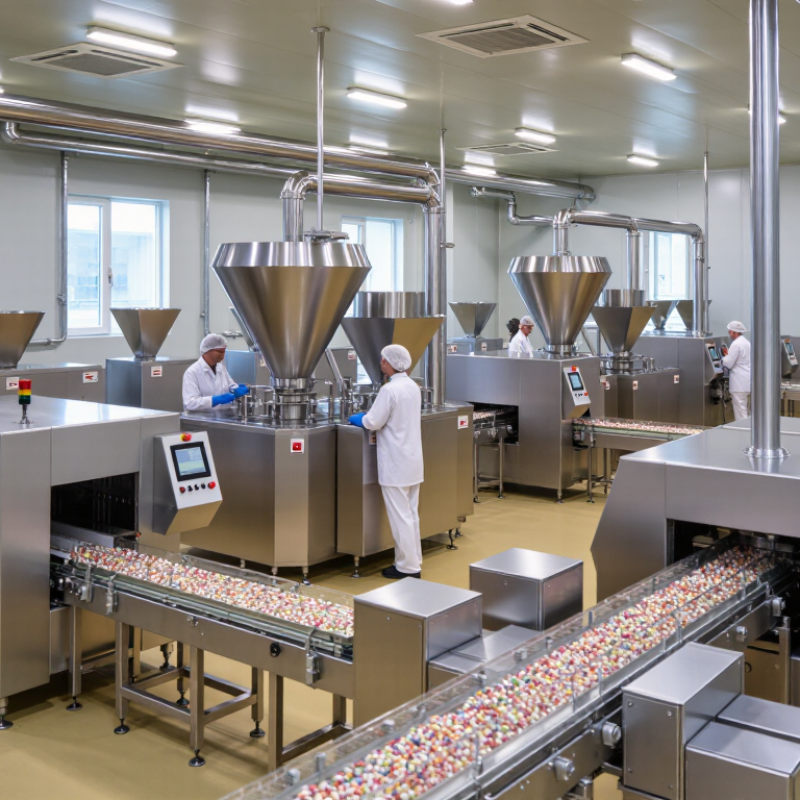
Table of Contents [Hide]
Overview of China’s Candy Machine Manufacturing Industry
China’s candy machine manufacturing industry benefits from a broad industrial base, established metalworking supply chains, and access to automation components. The World Bank’s World Development Indicators put China’s manufacturing value added at roughly US$4.7 trillion in 2023. This figure covers manufacturing as a whole, not confectionery equipment alone, but it helps explain the scale of the supplier ecosystem. For buyers, that can mean more choices in cooking, depositing, cooling, and packaging equipment.
Trade data offers another useful lens. UN Comtrade classifies machinery for making confectionery under HS 843820, alongside equipment for cocoa and chocolate production. This category helps buyers compare international trade flows, though it does not separate candy machines from related machinery. Look beyond export figures. A compact depositor may suit a small line, while a continuous cooker needs stable heat control, cleanable contact surfaces, and reliable spare parts.
The range is wide. So is the variation in build quality. A polished demonstration is not proof of steady output across a full shift. Ask for line-speed records, product-changeover details, and service response times. Check whether the quoted capacity matches your candy’s size, recipe, and cooling conditions. One detail is often overlooked: factory acceptance tests should use agreed product specifications, not just an empty machine cycle. The picture remains imperfect; public reports rarely isolate China’s candy-machine sector, so buyers should verify supplier claims directly.
China Best Candy Machine Manufacturers for Global Buyers - Overview of China’s Candy Machine Manufacturing Industry
| Equipment Category | Typical Application | Common Line Functions | Key Buyer Checks |
|---|---|---|---|
| Hard-candy cooking and depositing equipment | Boiled sweets, filled hard candy, and molded sugar confectionery | Syrup preparation, cooking, depositing into molds, cooling, and demolding | Confirm recipe compatibility, cooking controls, mold format, and the stated capacity basis. |
| Gummy and jelly production lines | Gelatin-, pectin-, or starch-based gummy and jelly products | Ingredient mixing, cooking, depositing, cooling or setting, and demolding | Check depositor accuracy, cleaning access, mold options, and suitability for the chosen gelling system. |
| Chocolate processing and molding equipment | Chocolate bars, pralines, shells, and molded pieces | Melting, temperature conditioning, depositing, vibration, and cooling | Verify temperature-control range, mold dimensions, cooling requirements, and available test procedures. |
| Chewing-gum and bubble-gum equipment | Gum slabs, sticks, pellets, and coated gum products | Mixing, extrusion or forming, sizing, conditioning, and optional coating | Match the forming method to the product format and confirm downstream conditioning and coating needs. |
| Candy coating and panning equipment | Sugar-coated, polished, or chocolate-coated centers and confectionery pieces | Batch tumbling, coating application, drying, and polishing | Ask about batch size, coating method, airflow or drying controls, and cleaning procedures. |
| Candy forming and cutting equipment | Ropes, strips, pieces, and shaped sugar or chewy confections | Roping, sizing, cutting, stamping, or rolling, depending on the product | Confirm product dimensions, changeover requirements, and whether tooling is included. |
| Confectionery packaging equipment | Individual pieces, bags, trays, and cartons | Feeding, weighing or counting, wrapping or bagging, sealing, and coding | Specify pack format, film type, target speed, coding needs, and integration with upstream equipment. |
| Automation and line integration | Coordinating production, conveying, inspection, and packaging stages | Conveying, controls, operator interfaces, safety systems, and optional inspection equipment | Define interface responsibilities, control language, electrical requirements, and acceptance-test criteria. |
Buyer note: Equipment configuration, output, utilities, and food-contact materials vary by model and product recipe. Request a written specification, confirm applicable destination-market requirements, and evaluate performance using agreed sample products and acceptance criteria.